Show the source.
Link factual claims to their publications. Keep dates, study boundaries, and the scale of the evidence visible.
ABOUT / RESIDUAL AFTERMATH
We study what remains after the event has become history.
Residual Aftermath is an initiative by Carrie A. Shuster focused on the environmental legacies of warfare. It connects research, environmental forensics, and public writing to ask a persistent question: what happens to the materials, landscapes, and living systems left behind?
THE PURPOSE
The end of fighting does not settle what happens to a contaminated beach, a damaged habitat, or a residue buried in sediment. Those questions require measurement, historical context, and attention to how environmental processes unfold.
Residual Aftermath makes that work accessible. The site introduces warfare ecology, connects readers to published studies, and explains the difference between detecting a substance and demonstrating its source, movement, persistence, or effect.
Our focus includes military preparation and training, active conflict, disposal, and postwar legacies. Environmental consequences can emerge across all of these settings.
THE RESEARCHER
ENVIRONMENTAL RESEARCHER
U.S. NAVY VETERAN
From troubleshooting aircraft to investigating what military activity leaves behind.
Carrie served as an aircraft electrician and troubleshooter on F/A-18E/F Super Hornets with VFA-102, the Diamondbacks, aboard USS George Washington. That experience informs her interest in the materials, maintenance demands, and environmental consequences of military systems.
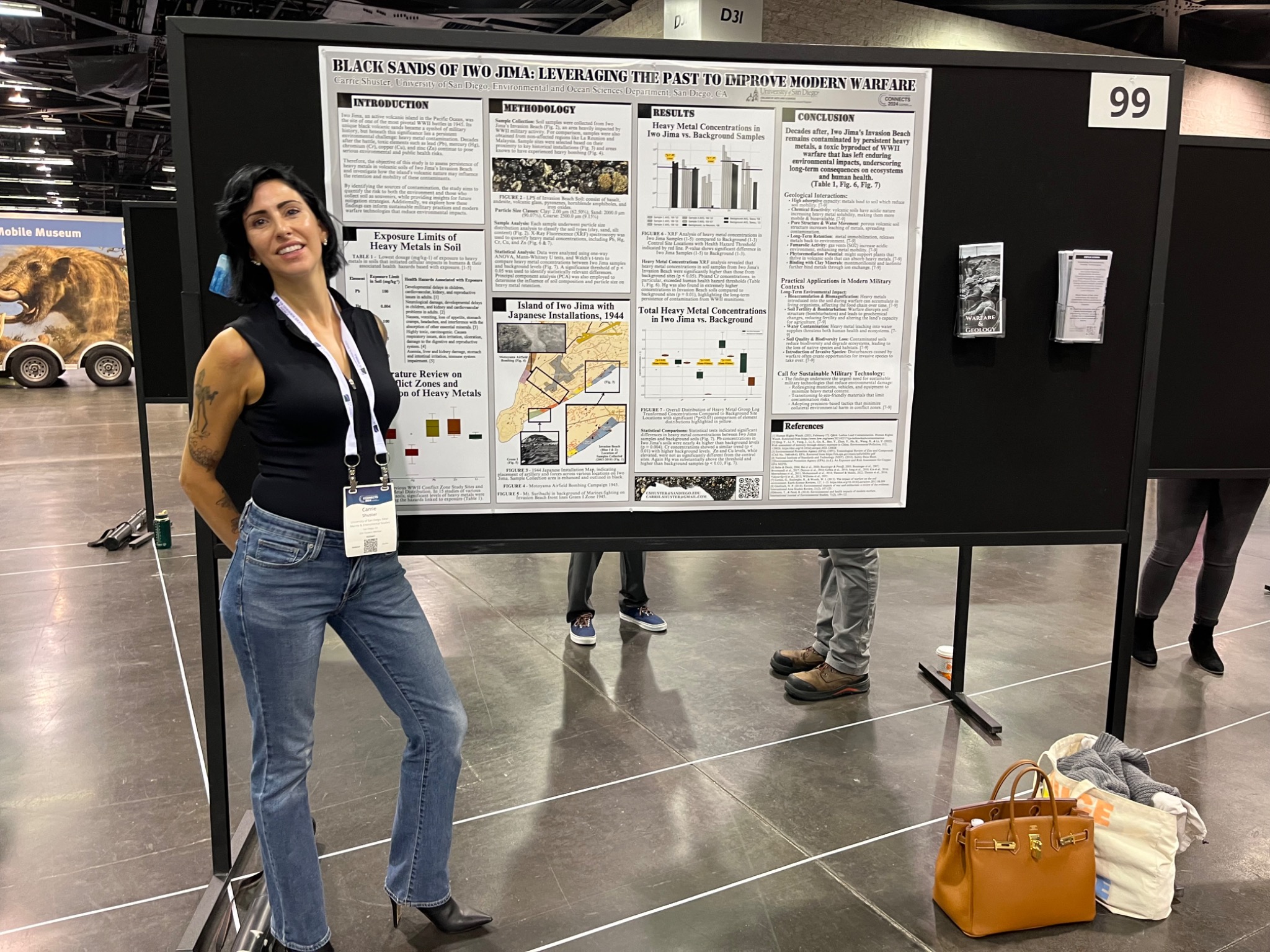
Her environmental research includes legacy contamination on Iwo Jima, coastal marsh change in northern Mission Bay, and the environmental fate of warfare-related residues. Her work brings together environmental forensics, spatial analysis, historical records, and evidence synthesis.
Her published article, Black Sands of Iwo Jima: How the Past Can Improve the Future of Warfare, examines heavy metal contamination in sand from Iwo Jima’s Invasion Beach.
Read the Iwo Jima paper ↗Environmental Forensics, 26(3), 393–411 (2025); first published online in 2024.
HOW WE COMMUNICATE SCIENCE
Link factual claims to their publications. Keep dates, study boundaries, and the scale of the evidence visible.
Distinguish observations from interpretations and proposed mechanisms. Missing evidence is not evidence that a process cannot occur.
Separate published findings from work in progress. Avoid presenting provisional screening or coding decisions as established environmental facts.
CONTACT / RESIDUAL AFTERMATH
Get in touch about research, collaborations, publications, or equipment support.
For inquiries about Residual Aftermath and its work on the environmental legacies of warfare, email us directly.
residual.aftermath@gmail.com ↗CONTINUE EXPLORING
Start with the warfare ecology field guide and publication collection, or explore Carrie’s public writing on the environmental consequences of military activity.
SUBSTACK MEMBERSHIP
A paid subscription supports Carrie’s public writing and research work. See available plans and paid posts on Substack, where membership and billing are managed.
Become a member on Substack ↗Already subscribed? Sign in and read on Substack ↗. Membership does not unlock pages on this website; its public resources remain freely accessible.
IMAGE PROVENANCE
Images provide context. Captions should identify the creator, place, date, original source and reuse basis separately from the person who supplied a copy.
To complete an entry, provide the original source or archive record, photographer credit, date and permission or license information. Send an image-source correction ↗